Why Enhance Door Safety and Security for Global Buyers?

Time:2026-10-20 Author:Madeline
0%

For global buyers, a door is more than an entry point. It protects people, equipment, documents, and daily business operations. A weak hinge, poor frame, or copied key can create serious risks. These details are easy to overlook during international purchasing.

How to enhance door safety and security depends on the building, location, users, and threat level. Experienced installers usually begin with the complete door system, not the lock alone. They examine the leaf, frame, hinges, glazing, closer, and access-control hardware. A reinforced frame may improve performance more than an expensive lock. Proper installation matters just as much. Even high-quality hardware can fail when alignment is poor.

Small details matter.

Global buyers should request clear product specifications, testing records, warranty terms, and maintenance guidance. Independent testing can support confidence in resistance, durability, fire performance, or weather protection. However, certifications should match the destination market and the intended application. Local professionals should also review emergency exit requirements and accessibility needs before purchase.

Security is never permanent.

Users change, technology ages, and buildings develop new weak points. Electronic access systems may provide audit trails, but they require dependable power, software updates, and backup entry methods. Mechanical solutions can be reliable, yet lost keys and uncontrolled duplication remain concerns. No single product solves every problem. Buyers should compare practical risks, installation quality, lifecycle costs, and after-sales support. Regular inspections can reveal loose fasteners, worn closers, damaged seals, or unusual frame movement before these issues become expensive failures. A realistic plan may be less impressive, but it is often safer.
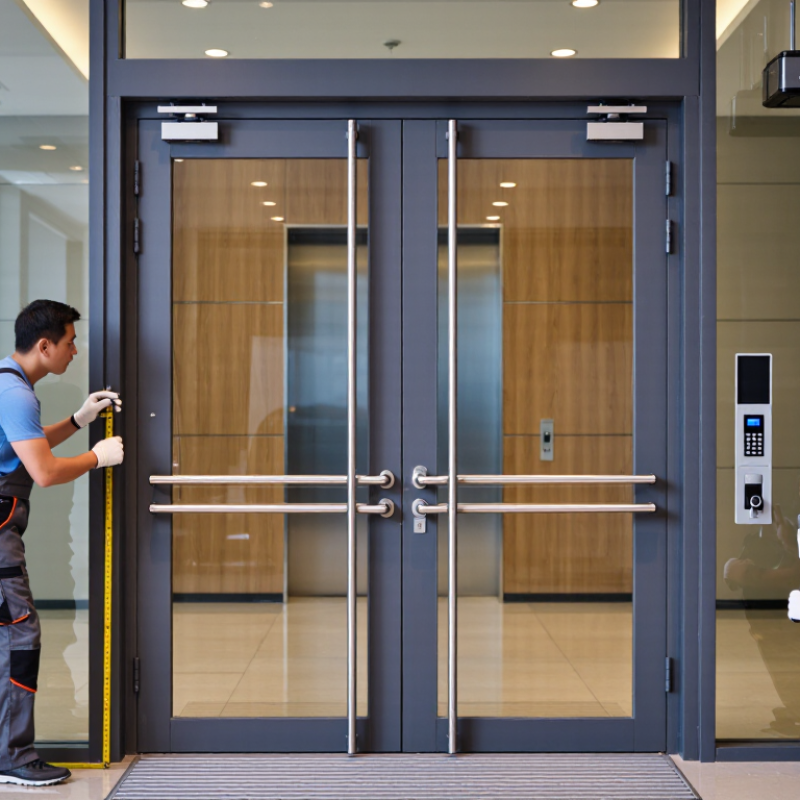
Why Enhance Door Safety and Security for Global Buyers?

Why Door Safety and Security Matter to Global Buyers

Why Door Safety and Security Matter to Global Buyers

For global buyers, a door is more than a barrier. It controls access, evacuation, privacy, and daily movement. NFPA’s Fire Loss in the United States During 2022 reported 1,504,500 fires and 3,790 civilian fire deaths. These figures show why emergency opening and clear exit routes deserve equal attention.

Security failures can also begin with small details. A weak strike plate, poor hinge alignment, or unreliable access reader may create avoidable risks. The 2024 Global Access Control Market analysis estimated continued growth in demand for electronic and integrated access systems. Yet technology cannot replace sound installation. A strong lock may still fail when a door closer is badly adjusted. Buyers should examine test records, cycle performance, corrosion resistance, and local service capability. Requirements also differ by climate, building type, disability access rules, and fire regulations. Global purchasing is rarely one-size-fits-all.

Tips: Check the complete door assembly, not only the lock. Request safety certificates and installation instructions. Test emergency release controls in person. Leave space for human error. Even experienced teams sometimes focus on intrusion prevention and overlook finger-pinch points or blocked escape paths. That oversight deserves honest review.

Key Risks in International Door Purchasing

Why Enhance Door Safety and Security for Global Buyers?

Key Risks in International Door Purchasing

International door purchasing involves more than choosing a strong panel and attractive finish. A door may fit the drawing but fail at the site. Different countries use different dimensions, opening directions, fire classifications, and testing methods. Confirm these details before production. Small measurement errors can create large installation gaps.

Security hardware creates another risk. Locks, hinges, closers, and access components must match the building’s use. A heavy entrance door needs properly rated hinges and reinforced fixing points. Otherwise, the frame may twist after repeated use. Fire-rated doors also require compatible frames, seals, and closers. Replacing one component can affect the tested performance.

Shipping conditions deserve careful attention. Salt air, humidity, vibration, and weak packaging can damage surfaces or distort frames. Ask for moisture protection, corner guards, clear packing lists, and inspection photos. Check certificates, test reports, material specifications, and installation instructions before payment. Documents matter.

Communication can still fail. A translated drawing may hide a critical detail. Use marked diagrams, sample approvals, and written confirmations for every opening. Independent inspection is useful, but it is not perfect. A checklist can miss a damaged hinge or an incorrect seal. Buyers should examine random units before shipment and again after arrival. The cheapest quotation may become expensive after delays, rework, and replacement parts.

Why Enhance Door Safety and Security for Global Buyers?

Key Risks in International Door Purchasing

International door buyers must evaluate more than appearance and price. Supply interruptions, cyber incidents, regulatory changes, natural catastrophes, and fire-related events can affect product availability, documentation, installation, and long-term building safety. The percentages represent the share of respondents identifying each issue as a major global business risk in a 2024 international risk survey.

Essential Safety and Security Features to Evaluate

Why Enhance Door Safety and Security for Global Buyers?

Global buyers should evaluate door safety through real use, not attractive specifications alone. In field inspections, I have seen strong door panels weakened by poor installation. The frame, hinges, locks, and wall connection must work as one system. A multi-point locking mechanism can improve resistance to forced entry. Anti-lift protection is also important for sliding doors. Laminated or tempered safety glass helps reduce injury risks if the panel breaks. Check whether the hardware has been tested under recognized standards relevant to the destination market.

Security should not make daily use difficult. Look for smooth emergency operation, clear locking indicators, and reliable access controls. Finger guards can protect children near closing edges. Sensors should detect movement before contact, especially in busy homes or commercial entrances. Weather seals also deserve attention. Water, dust, and repeated temperature changes can damage internal components over time. Ask for test reports, maintenance instructions, installation records, and warranty terms. Documents are useful, but real installation quality still decides performance.

Tips: Inspect sample doors in person when possible. Open and close them repeatedly. Check hinge movement, lock alignment, glass edges, and sensor response. Ask who will install and service the door locally. Regional conditions may expose weaknesses that factory testing misses. I would not rely on one security feature alone. Even a premium lock can fail when the frame is poorly anchored. Safety expectations also change between projects, so review the design with a qualified local professional before purchase.

Why Enhance Door Safety and Security for Global Buyers? - Essential Safety and Security Features to Evaluate
Evaluation Dimension Essential Feature Relevant Standard or Benchmark What Global Buyers Should Verify Safety and Security Value
Burglary Resistance Tested door-and-frame assembly with reinforced construction, protected locking points, and resistance to forced entry EN 1627 resistance classes RC1 to RC6; higher classes indicate resistance to more demanding attack methods and tools Request a certificate identifying the complete tested assembly, including the door leaf, frame, hardware, glazing, and installation configuration Helps reduce vulnerability to physical attacks and prevents buyers from evaluating the door leaf without considering weak frames or hardware
Fire Resistance Fire-rated door set with controlled flame, smoke, and heat transmission performance EN 1634-1 commonly uses integrity classifications such as E30, E60, and E90; the number indicates minutes of tested integrity Confirm the required rating for the destination building, wall type, glazing, seals, closer, and installation method Supports compartmentation and provides additional evacuation time during a building fire
Smoke Control Intumescent and smoke-control seals correctly fitted around the door perimeter Smoke-control classifications and test methods vary by market; European projects may specify Sa or S200 performance under EN 13501-2 Check whether the smoke rating applies to the complete door set and whether replacement seals are approved for that assembly Limits the movement of toxic smoke, which is a major hazard during fires
Lock Cylinder Security Anti-pick, anti-drill, anti-bump, and anti-pull protection where appropriate EN 1303 classifies mechanical lock cylinders by security, durability, fire, corrosion, and key-related performance attributes Review the cylinder classification, key control process, attack-resistance test evidence, and compatibility with the selected lock case Reduces common manipulation and forced-removal risks while supporting controlled key duplication
Lock Case and Latching Multi-point or high-security locking, anti-thrust latch protection, and secure deadbolts where required Applicable lock and hardware standards depend on the market; performance should be assessed as part of the tested door assembly Verify bolt projection, latch strength, material, cycle testing, emergency egress requirements, and compatibility with the frame Improves resistance to prying and spreading attacks while maintaining reliable everyday operation
Hinge-Side Protection Security hinges, hinge bolts, or other anti-lift devices on outward-opening doors The protection should be included in the burglary-resistance test configuration rather than treated as an optional independent component Check the number, spacing, material, adjustment range, and load capacity of hinges and hinge-side protection devices Prevents attackers from exploiting the hinge side after removing or damaging exposed hinge pins
Security Glazing Laminated or specially tested glazing with retained fragments and secure bead installation EN 356 classifies impact-resistant security glass from P1A to P5A and higher attack-resistant classes P6B to P8B Confirm glass composition, tested dimensions, edge retention, glazing method, and whether the frame is included in the test Helps resist impact, delay penetration, and maintain a barrier after glass breakage
Door Closer and Self-Closing Reliable self-closing device with controlled closing speed and latching action EN 1154 covers controlled door-closing devices and uses power sizes from 1 to 7; the required size depends on door width, mass, and conditions Check door dimensions, weight, opening force, hold-open requirements, fire-door compatibility, and accessibility limitations Ensures fire and security doors return to the closed position without creating excessive operating force
Emergency Egress Fast, intuitive exit operation without a key where occupants must escape quickly EN 179 is commonly used for emergency exit devices operated by users familiar with the building; EN 1125 addresses panic exit devices for public areas Determine occupancy type, evacuation strategy, outside access requirements, signage, and local code obligations Balances unauthorized-entry resistance with safe evacuation during emergencies
Accessibility Manageable opening force, suitable clear width, accessible thresholds, and compatible hardware heights Requirements vary by jurisdiction; common assessments include clear opening width, threshold height, operating force, and visual contrast Measure the installed door rather than relying only on catalogue values, especially where closers or seals increase resistance Improves usability for people with limited mobility, strength, or vision while supporting legal accessibility obligations
Weather and Corrosion Resistance Durable finishes, protected hardware, effective gaskets, and drainage appropriate for the installation environment EN 12207 addresses air permeability, EN 12208 addresses watertightness, and EN 12210 addresses resistance to wind load for relevant door and window products Match the performance class to exposure, coastal conditions, temperature range, humidity, and wind conditions at the project site Protects security components from corrosion, deformation, leakage, and premature performance loss
Acoustic Performance Sealed door perimeter, properly fitted threshold, and tested door-set sound reduction Acoustic performance is commonly reported as weighted sound reduction, such as Rw, under applicable ISO or regional test methods Request test results for the complete assembly and check whether the stated value includes seals, glazing, threshold, and frame installation Improves privacy and occupant comfort, particularly in residential, hospitality, healthcare, and office applications
Electronic Access Control Credential-based access, audit trails, low-power warning, and mechanical override or safe fallback where required System design should consider IEC 60839-11-1 for electronic access-control requirements and local privacy and cybersecurity rules Evaluate credential security, encryption, offline operation, data retention, power-failure behavior, emergency release, and system integration Provides traceable access management and allows permissions to be changed without replacing mechanical cylinders
Installation Quality Correct anchoring, frame alignment, seal continuity, hardware adjustment, and protection of the wall-to-frame connection Performance claims generally apply only when the product is installed according to the tested or approved installation configuration Require installation instructions, approved fixing details, tolerance limits, inspection records, and maintenance responsibilities Prevents gaps between laboratory performance and real-world performance caused by weak fixing or incorrect adjustment
Maintenance and Lifecycle Documented inspection schedule, replaceable seals, serviceable hardware, and available spare components Inspection frequency should follow local regulations, building use, manufacturer instructions, and the intensity of door operation Confirm service intervals, wear indicators, spare-part availability, warranty conditions, and procedures for preserving certified performance Maintains safety and security performance over the service life and helps identify faults before failure

How Standards and Certifications Support Buyer Confidence

Enhancing door safety and security matters to global buyers because performance must remain reliable across different buildings, climates, and installation practices. Standards and certifications provide measurable evidence. They can verify resistance to forced entry, fire, impact, corrosion, and repeated use. Buyers should review test methods, product scope, and certification dates instead of trusting a general claim.

Experience also reveals practical gaps. A certified door may still perform poorly if the frame is misaligned or hardware is installed incorrectly. Reliable suppliers should provide test reports, material specifications, installation instructions, and traceable quality records. Independent laboratories add credibility because their evaluations reduce promotional bias. Local building requirements may also differ, so technical documents should be checked before purchase. This step is easy to overlook. It often causes delays.

Tips: Ask for complete certificates, not cropped images. Confirm whether the tested configuration matches the delivered door. Check hinges, locks, seals, and frame details together. Request maintenance guidance and evidence of production consistency. A useful question is simple: “What happens after installation?” Some buyers focus heavily on certification labels and ignore service support. That is understandable, but incomplete. Even strong testing cannot replace careful fitting, inspection, and regular maintenance. Truthfully, no document can predict every site condition. Clear records, honest limitations, and responsive technical support create stronger buyer confidence.

A Practical Framework for Comparing Secure Door Suppliers

When global buyers compare secure door suppliers, appearance should be the least important factor. Begin with the opening’s actual risks: forced entry, fire, moisture, noise, or heavy daily traffic. A warehouse door may need reinforced hinges and impact resistance. An apartment entrance may need controlled access and quiet closing. Record the door size, wall condition, climate, and expected cycles. Small details matter. A strong specification can still fail on weak masonry.

Ask each supplier for test reports, material grades, product drawings, and installation instructions. Check whether reports identify the exact model, dimensions, hardware, and testing date. Generic certificates deserve careful questions. Compare steel thickness, core structure, lock protection, hinge design, seals, and emergency release options. Review local building and fire requirements as well. Request project photos, maintenance records, and references from similar environments. A reliable supplier explains limitations clearly.

Use a scorecard covering tested performance, manufacturing consistency, installation support, spare parts, warranty terms, and communication. Give each category a weight before receiving quotations. Ask who checks welds, coating thickness, alignment, and final operation. Video inspections can help, but they cannot replace independent checks. A scorecard is useful, not perfect. A lower quotation may look attractive, yet unclear drawings or difficult adjustments can erase the saving. Leave room for uncertainty. The strongest suppliers accept practical questions and revise details when site conditions change.

FAQS

Why should global buyers assess more than the door lock?

A door controls access, privacy, movement, and emergency evacuation. The complete assembly includes the frame, hinges, seals, closer, strike plate, and lock. Small alignment problems can create serious failures. The lock is only one piece.

What safety features deserve practical testing?

Test emergency release controls in person. Check that escape routes remain clear. Inspect finger-pinch points around hinges and closing edges. A quick demonstration may reveal problems that documents miss.

Which records should buyers request?

Request complete certificates, test reports, material specifications, and installation instructions. Check certification dates and tested configurations. Cropped certificate images are not enough. Records should match the delivered door.

What performance tests are important for door systems?

Review forced-entry, fire, impact, corrosion, and cycle-performance results. Cycle testing shows how hardware handles repeated daily use. Corrosion evidence matters near moisture or coastal air. Test scope must match the intended building.

Can certification guarantee reliable performance after installation?

No certificate can predict every site condition. A certified door may still fail with a misaligned frame or poorly fitted hardware. This is easy to underestimate. Installation quality remains critical.

How should buyers consider different climates and buildings?

Requirements vary by climate, building type, accessibility rules, and fire regulations. A humid site may need stronger corrosion resistance. A busy entrance may require durable closers and hinges. One solution rarely fits every project.

What should buyers ask about support after delivery?

Ask what happens after installation. Reliable support includes maintenance guidance, technical assistance, and traceable quality records. Local service capability can reduce delays. Buyers sometimes overlook this part.

How can buyers leave room for human error?

Inspect the door during realistic use, not only during a formal demonstration. Check blocked exits, closing speed, reader response, and release access. Experienced teams can still miss simple hazards. Honest review is necessary.

Conclusion

For global buyers, door safety and security are essential to protecting people, property, and long-term investment. International purchasing involves risks such as inconsistent quality, weak materials, poor installation guidance, unclear specifications, and difficulty verifying supplier reliability. To understand how to enhance door safety and security, buyers should evaluate features including strong door cores, durable frames, dependable hinges, secure locking systems, resistance to forced entry, fire performance where relevant, weather protection, and safe operation for everyday users.

Standards and certifications can provide valuable evidence that a door has been tested for performance, durability, and safety. However, documentation should be reviewed carefully and matched with the intended application and local requirements. A practical comparison framework should consider product quality, testing records, customization capability, installation support, quality control, warranty terms, delivery consistency, communication, and after-sales service. By assessing suppliers through these factors rather than price alone, global buyers can make more confident decisions and select secure, reliable door solutions for residential, commercial, and public environments.

Madeline

Madeline

Madeline is a dedicated marketing professional with a wealth of expertise in our company's core offerings. With a keen understanding of the industry, she brings a unique perspective to her role, consistently delivering high-quality content that highlights the superior aspects of our products. As......